
Is a Girl Really Safe in Bangladesh?
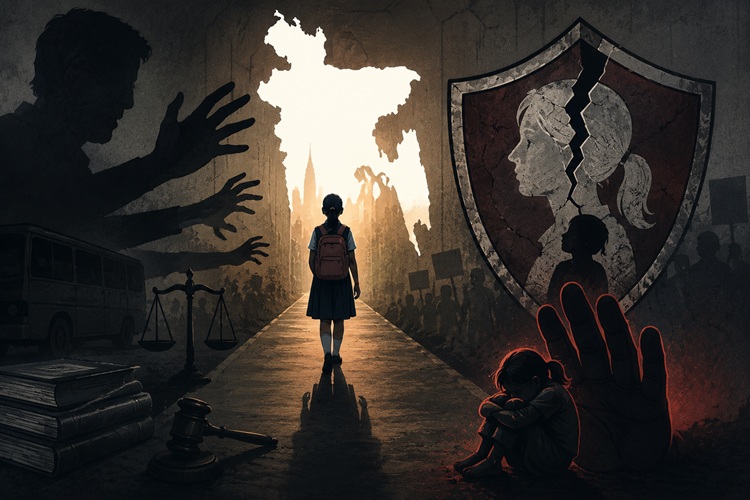
A Question that Haunts a Nation
Imagine a father in Dhaka taking his daughter to school. He watches her go through the gate. Then he feels a little better. This feeling does not last long. Deep down, he is worried and keeps thinking: “Is my daughter really safe?”
This fear is real, and many families in Bangladesh are worried about the same thing. From Dhaka to Comilla, Chittagong to Rangpur including other places, children, students, girls, and women are not safe at home, on the streets, in educational institutions, or even at workplaces. Respectively, there is no anti-harassment committee in many of the concerned places. Moreover, after knowing the harassment issue, the concerned authorities remain silent. Sometimes the concerned authorities may relate to the same, either directly or indirectly.
Every day, we hear news: a girl was attacked on a bus, a student was found dead in a supposedly safe area, or a child was brutally killed. These are not just stories; they are real incidents happening to families in Bangladesh. Children, students, girls, and women are always worried when they are out and about. This is the reality: In fact, their safety is not guaranteed anywhere or they cannot trust anyone. Sometimes, a trusted figure, like a relative, can also harass anyone for her or his own benefit.
Chronological Timeline of Systemic Failure
According to reports from organizations like Ain-o-Salish Kendra and Bangladesh Mahila Parishad, violence against women is increasing. Human rights groups say that many cases are not reported, investigations are slow, and not many people are punished for these crimes. Behind these numbers, there are names that Bangladesh should remember.
2016 — Sohagi Jahan Tonu
Sohagi Jahan Tonu was a student at Comilla Victoria College. She was killed inside Comilla Cantonment, a very secure area. Despite many protests, the investigation did not lead anywhere. Ten years later, the case remains unresolved, raising serious concerns about accountability and the effectiveness of the investigative process.
2017 — Rupa Khatun
Rupa Khatun was a law student. She was gang-raped and killed by bus staff in Tangail, who left her body behind. Although four people were sentenced to death, the case showed how unsafe public transport can be.
2019 — Nusrat Jahan Rafi
Nusrat Jahan Rafi was a 19-year-old student. She reported that her principal was harassing her. She did not get any protection. Later, she was killed after identifying her attackers. Sixteen people were sentenced to death, but her case raised a painful question: why did she have to die for justice to happen?
2020 — MC College Gang Rape & Noakhali Incident
At MC College in Sylhet, a woman was gang-raped by individuals who were widely reported to have influential connections. Afterwards, a video from Noakhali showed another woman being brutally assaulted. Although the law was amended to include the death penalty for rape, violence continued, proving that laws alone are not enough without proper enforcement.
2021 — Mosarat Jahan Munia
Mosarat Jahan Munia was a college student. She was found dead in a luxury apartment in Dhaka reportedly associated with a businessman. The case still remains unsolved.
2026 — Ramisha (7 Years Old)
Recently, seven-year-old Ramisha was brutally assaulted and killed. Her death shows that even the most vulnerable are not safe, raising a painful question: if an innocent child is not safe, then who is?
Causes Behind the Crisis
This situation does not exist because of one reason alone. It is the result of how society, laws, and institutions function. In many places, people still do not fully understand the importance of equality and respect for women’s safety, and sometimes the mental health of people is not proper and acceptable, which affects both behavior and the seriousness for which incidents are happening. On top of that, even when laws exist, they are not always enforced properly, so offenders believe they can escape accountability. The legal process is also slow and complicated, making it difficult for victims to continue seeking justice. Political influence further worsens the problem. All of this creates a system where violence continues, and accountability remains difficult to achieve.
The Legal and Institutional Paradox
The Constitution of Bangladesh says that everyone is equal before the law and has the right to life and personal liberty. Bangladesh also has several laws intended to protect children, students, girls, and women, but these laws are not always properly enforced:
- Section 154 of the CrPC says that police must immediately register reports regarding serious crimes. However, this often does not happen. On the other hand, influential local political figures frequently pressure victims’ families to settle matters privately, which destroys the opportunity to collect evidence properly.
- The Nari-O-Shishu Nirjatan Daman Ain, 2000 states that people who commit violence against women and children may face punishment ranging from imprisonment for different terms to life imprisonment or even the death penalty. According to the law, trials should be completed within 180 days, but many cases take more than a decade to finish because of the shortage of sufficient judges, as well as skilled and honest investigating team.
An Actionable Blueprint for Change
The concerned authorities cannot simply offer words of sympathy. In my opinion, to make Bangladesh safer for its children, students, girls, and women, the following changes must be implemented:
- Criminalize F.I.R. Delays: Any police officer who intentionally refuses to lodge an F.I.R. or delays a report must be held accountable.
- Independent Police Accountability Commission: An external body should handle complaints against police officers.
- Enforce the 180-Day Rule: Judges and prosecutors should complete sexual assault trials within 180 days.
- Dissolve Inactive Institutional Committees: Every university and workplace must have a harassment prevention committee led by women. If any authority attempts to cover up abuse, it must face punishment.
- Enact a Robust Witness Protection Act: Victims and witnesses must be provided with anonymity and 24/7 security. Intimidating witnesses should be punishable according to law.
- Ensuring Political Neutrality in Criminal Investigations: All political parties must expel and take appropriate legal action against members accused of violence against children, girls, and women.
- In sensitive cases, fast-track tribunals with due process safeguards should be established through appropriate legal reform.
Final Thought
Tonu, Rupa, Nusrat, Munia, and seven-year-old Ramisha deserved to live happy lives. Instead, their names have become statistics. Many girls and women in Bangladesh are suffering in silence because no one is listening. Every girl in Bangladesh has the right to live without fear. Yet today, basic human rights are being denied to half of the population. This is a failure of our collective humanity.
The question is no longer, “Is a girl really safe in Bangladesh?” The real question is: “How can we make the country safe for girls?”
Author: Sabiha Jamal Nitu, Student, Department of Law, Stamford University Bangladesh.