
Nobody to See : 45-Day Deadline of Affidavits; How Procedural Rigidities are Suffocating Litigants in HC
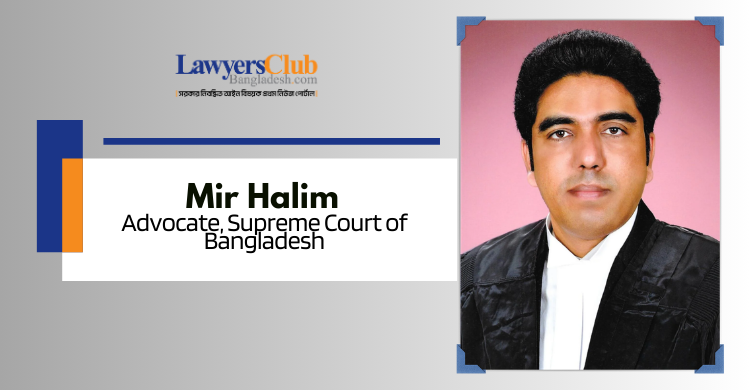
Adv Mir Halim
Is the social contract and the principle of natural justice being overlooked? Does justice reside merely in the literal adherence to legal text, or in the alleviation of citizen suffering? The 30 and 45-day validity periods for affidavits, enshrined in the 2012 amendment of the High Court Rules of 1973 have evolved into a silent financial tyranny and a procedural trap for litigants, even as India and Pakistan continue to reap the benefits of the older, more flexible system. In the judicial reality of Bangladesh, it is high time to dismantle these bureaucratic walls and make justice accessible. When the burden of long court vacations, reconstitution of the benches and administrative reshuffles manifests as a double financial penalty on the litigant, change is not just necessary; it is inevitable.
The 45-Day Limit: An Institutional Barrier to Justice
Justice is not confined to the delivery of a verdict; it depends heavily on how people-centric every step of the process is. In Bangladesh’s higher judiciary, one of the greatest harassment for litigants today is the “expiry date” of affidavits. According to the Bangladesh Supreme Court (High Court Division) Rules, 1973, the validity or “lifetime” of an affidavit is 30 days for Writ Petitions and 45 days for Civil and Criminal Motions. The rationale was to ensure that no further actions were taken against the order or that no changes occurred before filing. While legally a filing deadline, in the face of long vacations or administrative delays, this time limit has become a tool of silent oppression. It ignores the social contract and the principles of natural justice. It is a case of the “darkness beneath the lamp” an issue long ignored despite being right before our eyes.
Historical Context: British-1947 to 2026
The East Bengal High Court (later the East Pakistan High Court) was established through the High Court (Bengal) Order of 1947. Initially, the court followed the practices and procedures of the Calcutta High Court as they existed prior to August 15, 1947. Subsequently, the Pakistan Federal Court Rules of 1950 and the Supreme Court Rules of 1956 guided judicial activities. Recognizing that British-era rules were becoming obsolete, the High Court in Dhaka adopted its own rules in a “Full Court” meeting on July 18, 1958.
Following independence in 1971, the Constitution of 1972 was adopted, where Article 107 empowered the Supreme Court to frame its own rules. This led to the Bangladesh Supreme Court (Appellate Division) Rules, 1988 and the Bangladesh Supreme Court (High Court Division) Rules, 1973. While these were updated in 2012, they now appear static against global standards and the digital reality of modern Bangladesh. There is an urgent demand to make these rules more sophisticated, citizen oriented, tech-friendly and world-class.
The Evolution of Affidavit Deadlines
From the colonial era until 1947, the then, Calcutta High Court maintained a flexible policy:
Where a special time is limited for filing affidavits, no affidavit filed after that time shall be used except by leave of the Court.
This meant that with judicial leave, the doors remained open for justice. This balanced provision was maintained through the 1947 Order, the 1950 and 1956 Rules, 1958 Full Court and even the 1973 Bangladesh Rules. Notably, India (2013 Rules) and Pakistan (2025 Rules) still uphold this traditional, discretionary power.
The drastic shift occurred in 2012 when Bangladesh introduced a rigid 30 and 45-day limit. While intended to ensure speed and transparency, it has become a procedural barrier. Paradoxically, the Bangladesh Supreme Court (Appellate Division) Rules, 1988 (Order 8, Rule 13) still retains the ancient, liberal policy allowing the court to accept delayed affidavits. To honor the social contract, the High Court Division must also return to a more inclusive, hurdle-free process.
Application and Current Crisis
Under Chapter IVA, Rules 4, 5, and 6 of the High Court Division Rules, an application must be filed or moved within the specified affidavit period. Otherwise, it becomes “time-barred.” Since 1973, the population-to-case ratio has increased 25-fold. According to the 2024 Supreme Court Annual Report, new filings rose from 5,654 in 1973 to 82,082 in 2024, while pending cases skyrocketed from 24,063 to 589,651.
With the High Court closed for over 180 days a year, the crisis peaks after long vacations. Recently, after a 37-day break in March-April, hundreds of affidavits were found to have expired. When coupled with frequent bench reconstitutions and jurisdiction changes, an application filed on time may not be heard until after the 45th day. In such cases, the court often refuses to accept the “expired” affidavit, forcing the litigant back to square one.
Financial Penalty and Human Toll
The price of this procedural trap is inhumane. A litigant must first obtain new certified copies from the subordinate courts & tribunals (taking 15-20 days and extra money), pay for a new affidavit, re-file the case, and pay the Bar Association fees a second time. Why should a citizen pay a “double tax” for delays caused by state administration or court vacations?
Global and Regional Comparisons
Advanced judiciaries in the US, UK, and Singapore have transitioned to digital case management, verifying orders online rather than relying on the “freshness” of a paper copy. In India and Pakistan, an advocate’s undertaking or a supplemental short affidavit is often sufficient to confirm the status of an old order. We remain tethered to a 2012 amended framework that has lost its efficacy under the pressure of modern caseloads.
Undermining the Spirit of the Limitation Act
Although the Limitation Act of 1908 prescribes specific timeframes for filing suits, appeals, and other applications, it also provides provisions for the condonation of delay. However, the timeframe introduced by the 2012 amendment to the 1973 Rules regarding the validity of affidavits is sometimes condoned and sometimes not. Consequently, this rule has become inconsistent with current realities and detrimental to the principles of justice; thus, uniformity is essential to resolve this disparity.
Proposed Reforms for Resolution
To address these complexities, I submit the following alternative proposals for the consideration of the relevant policy-making authorities and stakeholders.
1. Amendment of Rules: The Primary Solution
The Supreme Court of Bangladesh, by the powers conferred under Article 107(1) of the Constitution, may effect necessary amendments to the Supreme Court (High Court Division) Rules, 1973. To revise or extend the 30 and 45-day limitations for affidavits stipulated in Rules 4(4), 5(6), and 6(6) of Chapter IVA, the Rule Committee may, pursuant to Rule 7A of Chapter IA, submit a recommendation for the consideration of the Full Court.
“Given the current population-to-case ratio and multifaceted administrative challenges, stakeholders suggest extending these periods to 60 days for Writ Petitions and 90 days for Civil and Criminal Motions.”
The objective is to ensure that once an affidavit is sworn, it remains valid until the disposal of the application, thereby stabilizing administrative functions and saving the precious time and resources of litigants as well as courts.
2. Issuance of Practice Directions: An Interim Solution
Under Rule 1 of Chapter IIIB, the Honourable Chief Justice may issue Practice Directions for the efficient conduct of judicial and administrative business, provided they are consistent with existing rules. Currently, some courts accept expired affidavits while others do not; this disparity can be eliminated by a directive ensuring that a validly filed affidavit remains effective until the case is disposed of. Notably, although the power to issue such directions was adopted via amendment in 2012, it has yet to be exercised for this purpose.
3. Acceptance of Advocate’s Certification: An Alternative Solution
The purpose of the 30/45-day rule is to ascertain the current status of the order in the subordinate court. If the Court requires such confirmation, rather than mandating the collection of new certified copies, it could accept a ‘Short or supplemental Affidavit’ or a ‘Certificate’ from the conducting Advocate confirming that the status of the order remains unchanged. This practice is prevalent in India and Pakistan and requires universal adoption in our jurisdiction to move beyond occasional mentions.
4. Clarification on the Calculation of Days: An Alternative Solution
If the 45-day limit cannot be modified immediately, a clarification should be issued regarding the calculation of time. A provision should be added stating that the Supreme Court’s long vacations, public holidays, and the intermediate periods caused by bench reconstitutions or jurisdictional shifts shall be excluded from the calculation of the “limitation period.” Time should be counted based on actual “working days” so that litigants do not suffer for administrative reasons.
5. Financial and Procedural Alignment: A Supportive Solution
Another alternative is to allow the transfer or adjustment of previously paid Bar Association fees, affidavit fees, and government stamps to a new application if re-filing becomes necessary due to administrative reasons (e.g., court changes or long vacations). While challenging to implement in the current context of Bangladesh, it is not impossible.
6. Automated File Transfer System: A Supportive Solution
In instances of jurisdictional shifts or bench reconstitutions, a system should be established to automatically transfer all original records and certified copies to the new Bench. This would prevent litigants from falling into the complexities of re-filing and fresh cause-list entries, ensuring the disposal of applications within a reasonable timeframe.
7. Preparation for Online Verification: A Supportive Solution
As a futuristic measure, a system of verifying the authenticity of orders and current case status through the online cause-lists and digital record sheets of subordinate courts should be encouraged. This would reduce the absolute dependency on physical paperwork and significantly save judicial time.
The Time for Change is Now
The goal of the judiciary should be to facilitate justice, not complicate it. In the digital age, the 30/45-day limit is nothing more than a “procedural trap.” We hope that under the current mentorship, supported by bar associations and stakeholders, these bureaucratic hurdles will be removed and The Supreme Court (High Court Division) Rules, 1973 will be updated soon. Let the courts be a place of relief. As an advocate and public policy analyst, I offer these proposals with the singular hope of making the path to justice effective for every citizen.
Adv Mir Halim: The author is an Advocate of the Supreme Court of Bangladesh and a Public Policy Analyst.